


Subjective cognitive decline—self-reported worsening of confusion or memory—is an important public health indicator because it may affect daily functioning, independence, and the need for support. Although subjective cognitive decline is not equivalent to a clinical diagnosis of Alzheimer’s disease or related dementias, it can help identify populations experiencing cognitive concerns and inform public health planning.
BRFSS data reveal meaningful state-to-state differences in both cognitive decline and dementia-related caregiving.
Informal caregivers provide essential support to many individuals living with dementia or cognitive impairment. However, the availability of informal caregiving may not align geographically with the population experiencing subjective cognitive decline. Few studies have examined state-level variation in subjective cognitive decline and dementia-related caregiving across the US, in part because large, publicly available datasets with comparable state-level measures are limited.
Here we used nationally representative data to generate estimates of the population of adults living with self-reported confusion or memory loss and informal caregivers to someone with dementia across US states. The Behavioral Risk Factor Surveillance System (BRFSS) collects state-specific data pertaining to health risk behaviors, chronic conditions, preventative health services, and health care accessibility. We used BRFSS data to estimate state-level variation in the size of the self-reported subjective cognitive decline and dementia-related caregiving populations, and the association between the two.
States with higher levels of subjective cognitive decline also tended to have higher levels of dementia-related caregiving.
AUTHORS
Hunter Dreisbach
University of Michigan
Jonathan Martindale
University of Michigan
Matthew A. Davis
University of Michigan
Lauren B. Gerlach
University of Michigan
What we did.
We conducted a cross-sectional analysis using BRFSS data from 2019–2022 to examine the relationship between subjective cognitive decline and dementia-related caregiving across US states. It’s important to note that not all BRFSS modules are available for every state, every year. Hence, collecting data from 2019–2022 allowed for a uniform dataset to be constructed for all US states, excluding Massachusetts, Montana, New Jersey, and the District of Columbia. Subjective cognitive decline was measured as the weighted percentage of adult respondents age 45 and older who reported confusion or memory loss that was happening more often or getting worse during the previous 12 months. Dementia-related caregiving was measured as a percentage of all adults aged 18+ who identified as caring for someone with Alzheimer’s disease, dementia, or another cognitive impairment disorder.
To account for differences in age and sex across states, both measures were adjusted using direct rate adjustment to the estimated 2022 U.S. population from the American Community Survey. For visualization, both measures were collapsed into quintiles and used Pearson correlation to estimate the association between state-level subjective cognitive decline and dementia-related caregiving.
Combining cognitive decline and caregiving measures provides a more complete picture of dementia-related needs across the United States.
What we found.
- We identified considerable state-level variation in the proportion of adults aged 45 years and older with subjective cognitive decline after adjustment for age and sex (coefficient of variation = 20.5%, Figure 1A). States with the highest levels of cognitive decline included Alabama, Arizona, and Tennessee, where adjusted estimates ranged from 14.4 to 17.3 per 100 adults aged 45 years and older. States with the lowest levels of self-reported cognitive decline include New Hampshire, North Carolina, and Illinois (No. per 100 varied from 6.0 to 7.0). Cognitive decline appeared most concentrated in Southern states, with the lower levels observed in parts of the Midwest and Coastal regions.
- Age and sex adjusted dementia-related caregiving also varied across states, though slightly less than subjective cognitive decline (coefficient of variation = 17.3%, Figure 1B). States with the highest percent of dementia-related caregivers include Hawaii, Tennessee, and Arkansas (5.4 to 6.5 per 100). States with the lowest dementia-related caregiver populations include Nebraska, Illinois, and North Dakota (2.7 to 3.3 per 100).
- We found a statistically significant, positive association between subjective cognitive decline and dementia-related caregiving (Pearson correlation coefficient = 0.47; p-value < 0.001).
Figure 1.
Variation in (A) subjective cognitive decline and (B) dementia-related caregiving across US States.
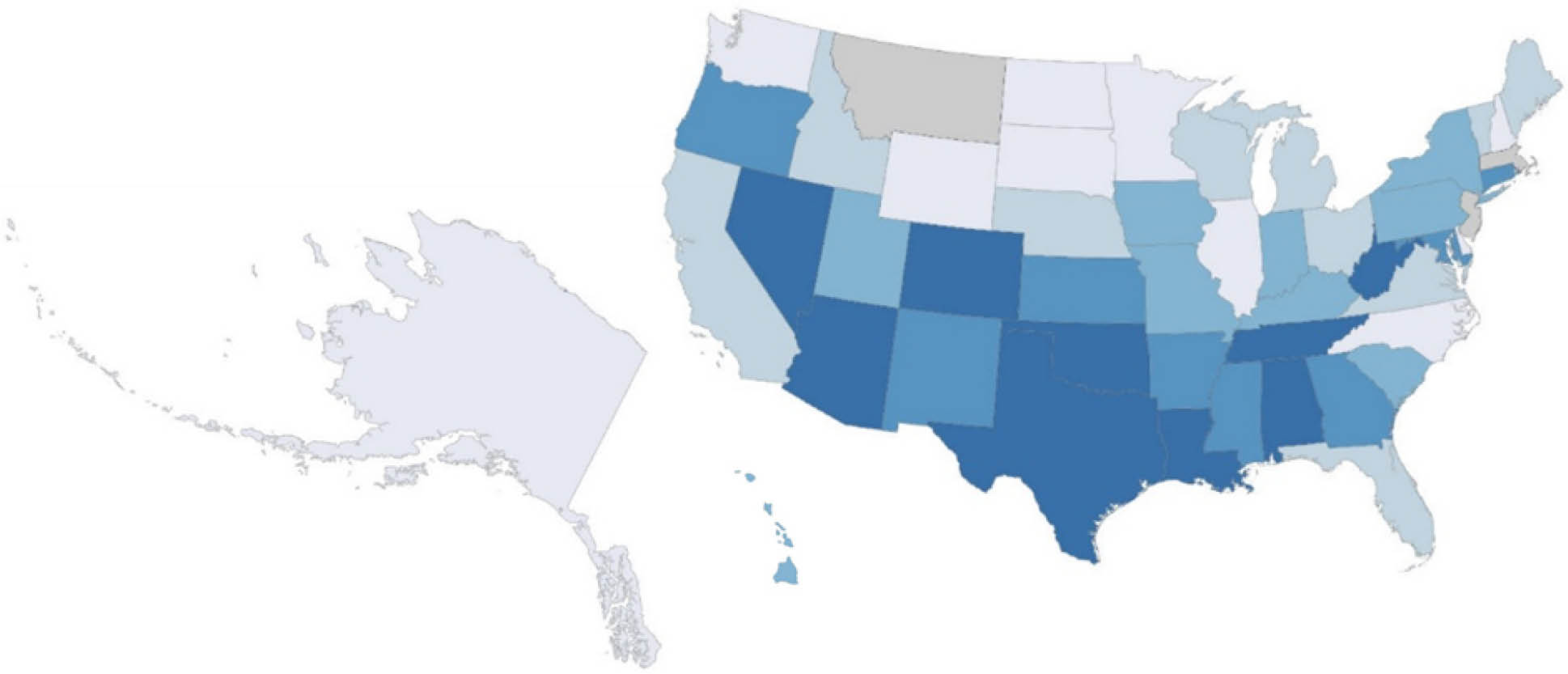
A. Subjective cognitive decline per 100 adults aged 45+
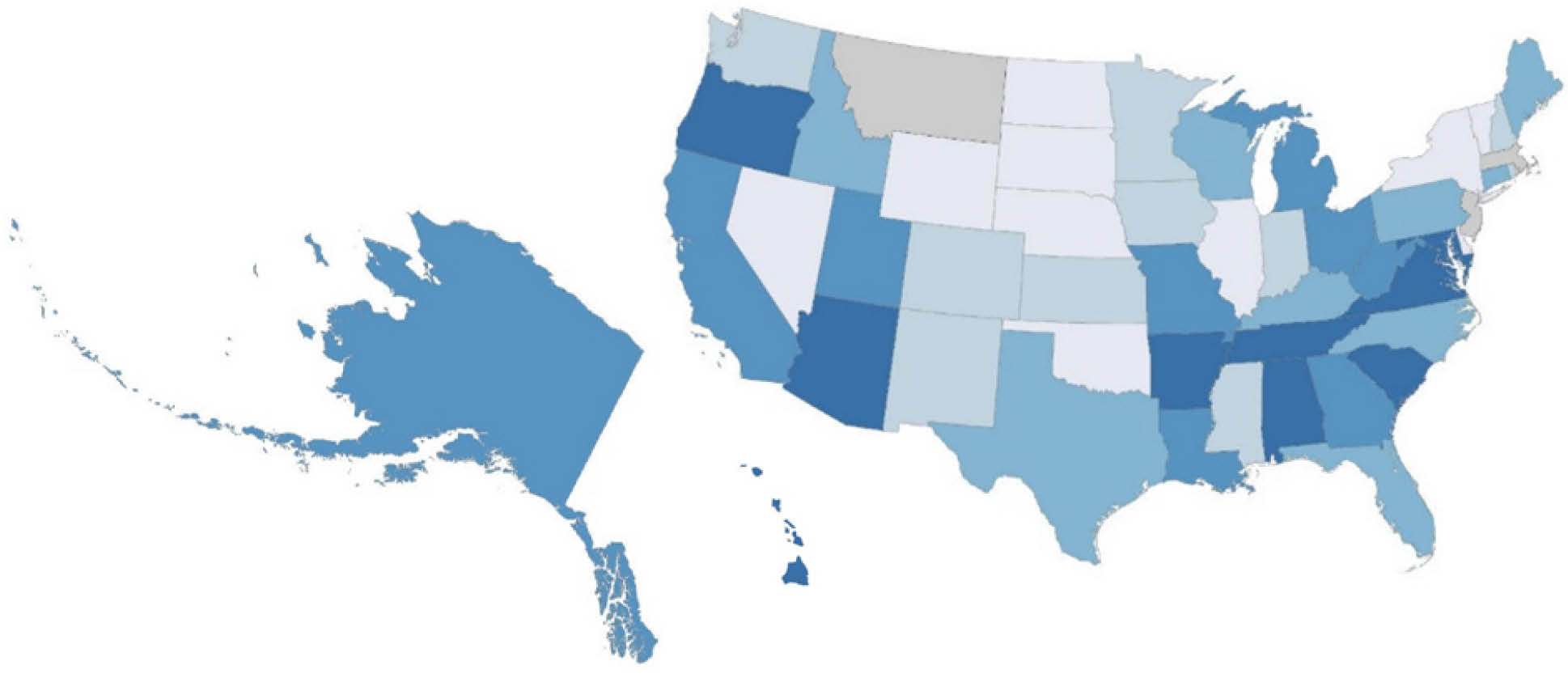
B. Dementia-related caregiving per 100 adults aged 18+
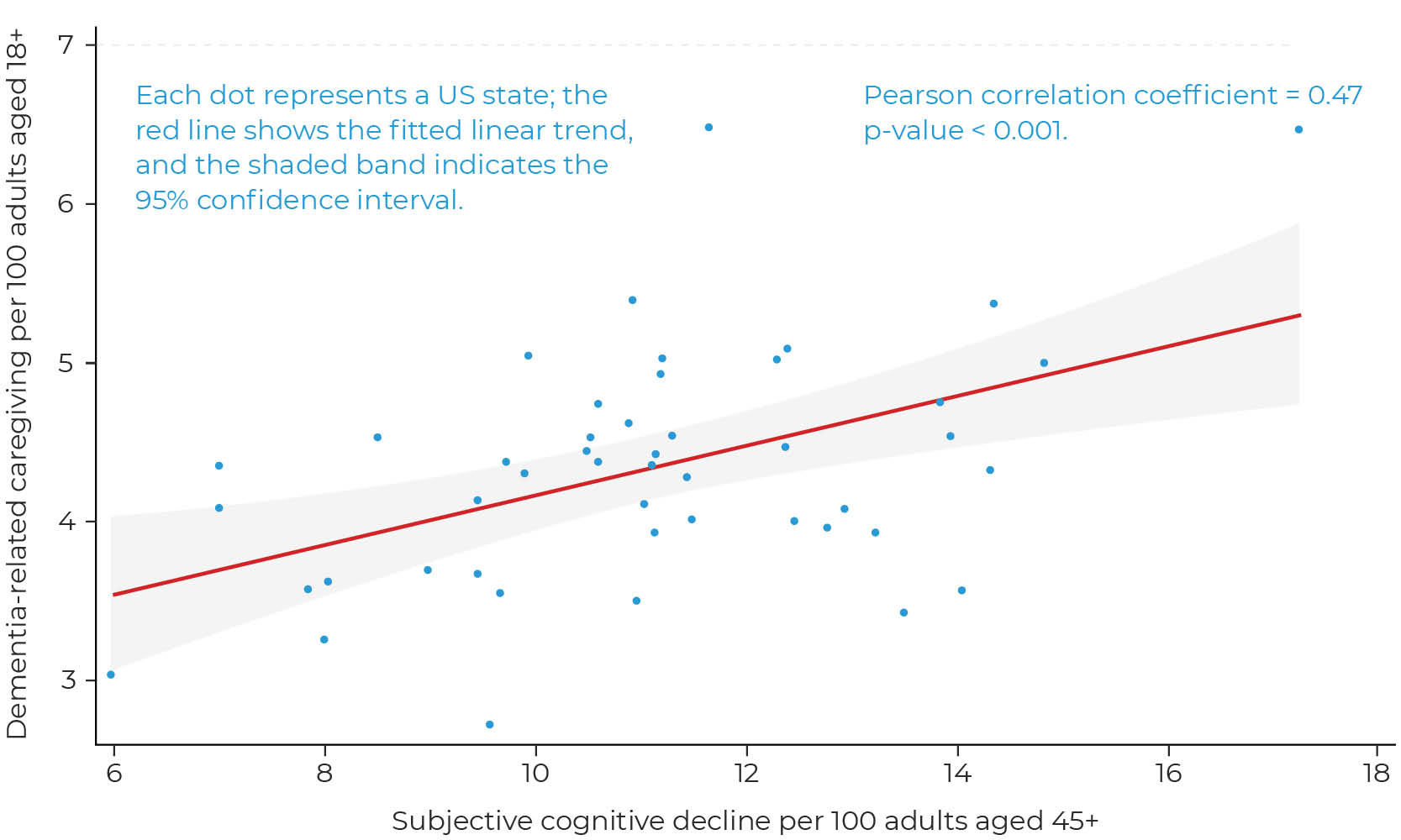
Figure 2.
Association between subjective cognitive decline (A) and dementia-related caregiving (B) across US states.
What does this mean for ADRD research?
These findings are a first step in understanding the relationship between subjective cognitive decline and dementia-related caregiving across US states. Our analysis reveals modest variation between states in terms of self-reported cognitive decline. Our results also show modest variation between states in terms of proportion of adults who provide informal dementia-related caregiving services, however less variation than self-reported cognitive decline. As expected, there is a moderate positive correlation between the two measures.
Overall, this data brief demonstrates the strength of BRFFS as an easily accessible and publicly available dataset in examining geographic variation at the state level for dementia researchers. BRFSS contains multiple measures, (e.g., subjective cognitive decline and dementia-related caregiving), that can be combined to get an accurate picture of state-level relationships in ADRD indicators. Future analyses could strengthen these findings by incorporating additional state-level characteristics such as socioeconomic factors, rurality, racial and ethnic composition, and long-term care services and supports. County-level analyses may also help identify more local variation that is obscured in state-level estimates.
Publicly available BRFSS data can help uncover patterns that inform dementia research and public health planning.
References
Bynum, Julie. Behavioral Risk Factor Surveillance System (BRFSS) for Dementia Researchers, 2015-2024. Ann Arbor, MI: Inter-university Consortium for Political and Social Research [distributor], 2026-02-02. https://doi.org/10.3886/E154421V4
Bynum, Julie. Nationally Representative Behavioral Risk Factor Surveillance System (BRFSS) Cognitive Decline and Caregiver Datasets, 2019-2022. Ann Arbor, MI: Inter-university Consortium for Political and Social Research [distributor], 2026-01-23. https://doi.org/10.3886/E244591V1
National Center for Chronic Disease Prevention and Health Promotion, Division of Population Health. Behavioral Risk Factor Surveillance System (BRFSS). Centers for Disease Control and Prevention, June 3, 2026. Available from: https://www.cdc.gov/brfss/
U.S. Census Bureau. (2022). American Community Survey 5-Year Data 2022 Subject Tables (S0101). https://www.census.gov/data/developers/data-sets/acs-5year/2022.html
The Center to Accelerate Population Research in Alzheimer’s (CAPRA) is an NIH/NIA-P30 funded Center on the Demography and Economics of Alzheimer’s Disease and Related Dementia (P30AG066582).