


Among older adults, a decline in cognitive functioning can be associated with significant changes to a person’s ability to function and live independently. Limited treatment options have fueled interest in new strategies to promote and preserve healthy cognitive aging. One mechanism for explaining differences in cognitive aging and/or pathology that has emerged in recent research is cognitive reserve. A variety of factors, such as educational attainment, have been shown to impact an individual’s cognitive reserve.
Overall, each increase in family income category was associated with higher cognitive reserve
However, one factor that may be related to cognitive reserve that has not been explored is financial income level. For example, higher income may increase access and utilization of healthcare, education, and nutrition while reducing stress exposures. To better understand this relationship, we used data from NHANES, which collects data from health interviews, questionaries, and physical examinations and has been used to study socioeconomic, behavioral, and environmental conditions related to Americans’ health. NHANES is among the largest nationally representative studies that provide publicly available data. The 2011–14 NHANES cycles included cognitive function assessments among older adults.
AUTHORS
Hunter Dreisbach
University of Michigan
Jonathan Martindale
University of Michigan
Megan Jensen
University of Michigan
Lauren B. Gerlach
University of Michigan
Matthew A. Davis
University of Michigan
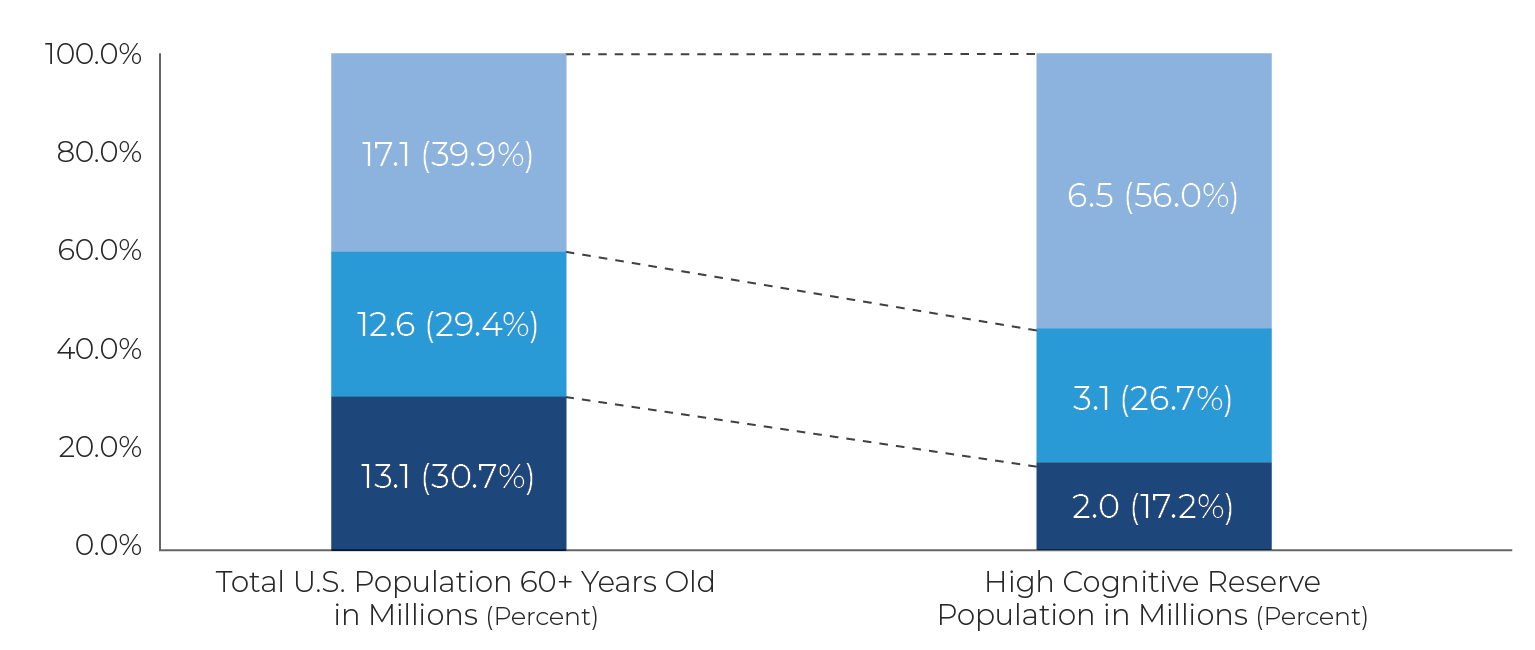
Figure 1
Distribution of Family Income in the Overall Older Adult Population versus among Older Adults who have High Cognitive Reserve.
 |
Low Income |
 |
Mid Income |
 |
High Income |
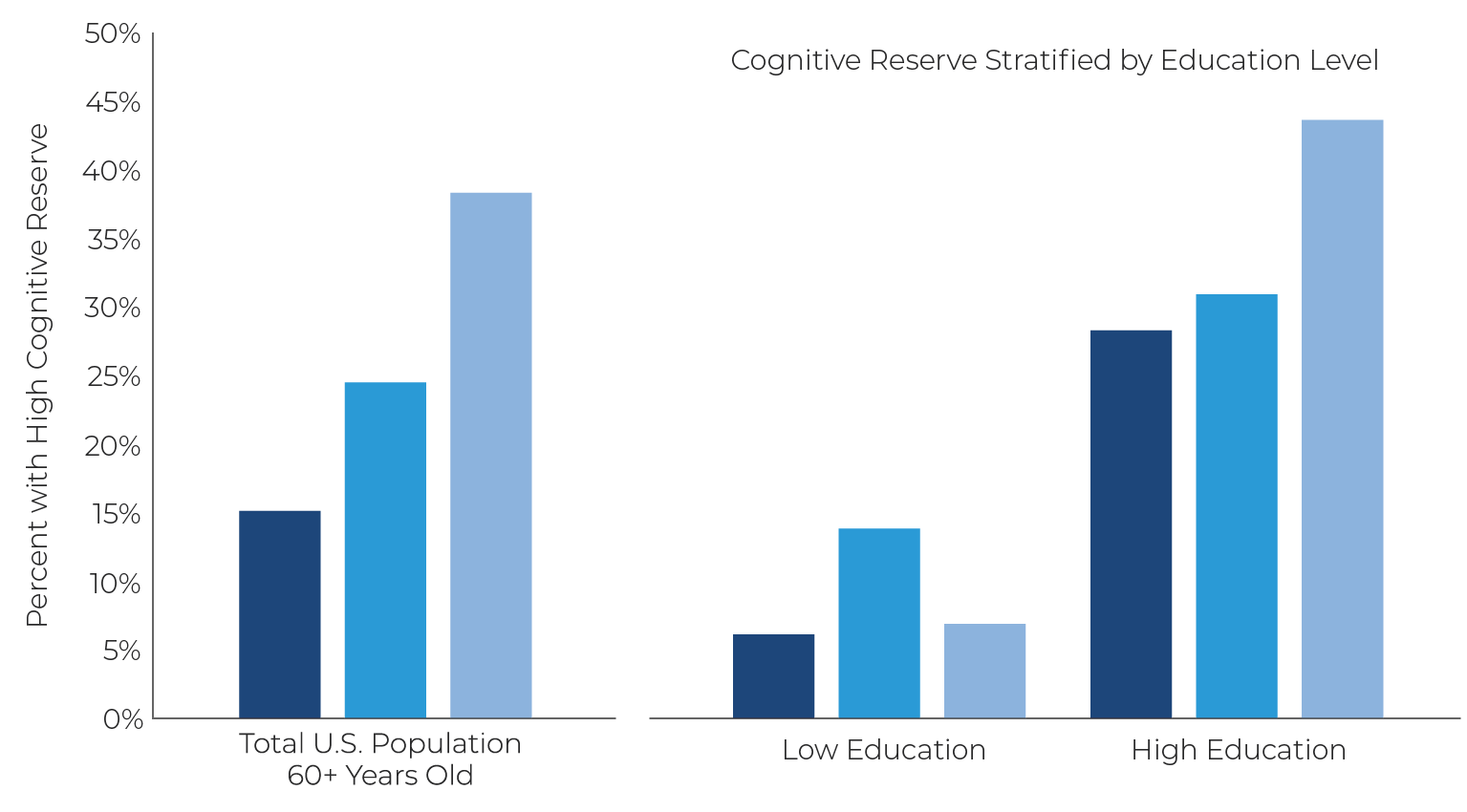
Figure 2
Association between Family Income Level and High Cognitive Reserve by Educational Attainment.
|
Low Income |
|
Mid Income |
|
High Income |
What we did.
We conducted a cross-sectional study using combined 2011–14 NHANES data to examine the relationship between family income level and cognitive reserve among older adults (≥60 years). Cognitive reserve was assessed through individual performance in relation to average test scores after accounting for age and sex. Residuals from the linear regression model were used to identify high cognitive reserve defined as scoring one standard deviation above the mean. Family income level was estimated based on gross family income as a ratio to the federal poverty level (FPL): Low (<200% FPL), Middle (200% to 399% FPL), and High (≥ 400% FPL). The association was examined separately by educational attainment (‘High’ some college or more versus ‘Low’ High School or less).
Our findings relate to the expansive issue of income inequality in the United States and demonstrate that income, above and beyond that of known factors, may affect healthy cognitive aging.
What we found.
- Among the estimated 42.8 million Americans 60 years and older, there is an estimated 11.7 million (27.3%) identified as having high cognitive reserve.
- While the estimated 17.1 million older adults who have high family income (≥ 400% FPL) comprise 39.9% of the older adult population, they represent 56.0% of older adults who have high cognitive reserve (Figure 1).
- Overall, each increase in family income category was associated with higher cognitive reserve—the percent of older adults with high cognitive reserve increased from 15.3% among those of low income to 38.3% among those of high income (Figure 2). When analyzed separately by educational attainment, higher family income was associated with higher cognitive reserve particularly among those of high education.
What does this mean for ADRD research?
This study demonstrates how nationally representative NHANES data can be used to evaluate factors associated with cognitive outcomes. Our results show that family income, after accounting for age, sex, and educational attainment, is associated with higher cognitive reserve in older adults. Our findings relate to the expansive issue of income inequality in the United States and demonstrate that income, above and beyond that of known factors, may affect healthy cognitive aging.
The data used to create this brief report are available and can be found at the
CAPRA data resources page.
The Center to Accelerate Population Research in Alzheimer’s (CAPRA) is an NIH/NIA-P30 funded Center on the Demography and Economics of Alzheimer’s Disease and Related Dementia (P30AG066582).
References
Bynum, Julie. National Health and Nutrition Examination Survey (NHANES) for Dementia Researchers, 2011-2014. Ann Arbor, MI: Inter-university Consortium for Political and Social Research [distributor], 2021-10-20. doi.org/10.3886/E151621V1
Centers for Disease Control and Prevention, National Center for Health Statistics. National Health and Nutrition Examination Survey Data. Centers for Disease Control and Prevention. www.cdc.gov/nchs/nhanes/index.html. Published 2011–2014.